
Daubert vs. Frye Standards
What You Will Learn in This Chapter
Before a jury ever hears your opinion, a judge decides whether they may. That decision runs through two standards separated by seventy years. Frye asked one question: is the method generally accepted in its field? Daubert kept that question and added four more, and in doing so it made the judge a gatekeeper who evaluates methodology rather than counting votes among experts.
This unit walks you through both standards and the two cases that followed Daubert, Joiner and Kumho, which together are known as the Daubert trilogy. You will learn what courts mean by reliability, which is not what psychometrics means by it, and why that single word causes more confusion in qEEG testimony than any other.
You will then examine how qEEG methods measure against the four Daubert criteria, the 1997 American Academy of Neurology position paper that argued they do not, the rebuttals that followed, and the paper's retirement in 2020. The unit closes with the practical side of expert work: qualification, the process of testifying, informed consent in a forensic examination, cautions, ethics, and recommendations from practitioners who have done this work.
IQCB Blueprint Coverage: This unit addresses IX. Clinical Practice/Forensic, specifically C. Understanding the Daubert vs. Frye standards and their application to the qEEG.
Learning Objectives
After completing this section, you will be able to:
State the Frye standard and explain the problems with the general acceptance rule.
List the Daubert criteria and explain the judge's gatekeeping function.
Describe how Joiner and Kumho Tire extended Daubert.
Distinguish the courtroom meaning of reliability from its psychometric meaning.
Explain how qEEG methods meet each of the four Daubert standards identified by Thatcher, Biver, and North (2003).
Summarize the 1997 AAN position paper, the rebuttals it drew, and its retirement.
Describe how an expert witness is qualified and what the process of testifying involves.
Identify the ethical obligations and the principal cautions that apply to forensic qEEG work.
Click the button below to hear the lecture over the Clinical Practice and Forensic unit.
U.S. Supreme Court Decisions on Admissibility
Standards of admissibility of evidence were developed to reduce the risk that legal matters would be vulnerable to pseudoscientific evidence based on methods that cannot be replicated, that is, methods unreliable for producing similar results at different times and in different places.
Sweet et al. (2018, p. 866) state that "it is important to recognize that decisions involving evidentiary standards are case-specific and are influenced by the individual expert, the procedures he or she uses, and the underlying scientific evidence in a particular case. Thus, it is quite possible that a particular expert's testimony might be accepted in one instance and denied in another, depending on whether his or her assertions in each specific case are judged to have a valid scientific base." It is important to avoid speculative opinions that stray beyond what the data support.
The Frye Standard for Admissibility of Evidence
For most of the 20th century, the Frye standard (Frye v. United States, 1923) gave requirements for the admissibility of evidence. This standard stated that experts can give evidence that must be generally accepted in their field of scientific practice. This criterion attempts to limit speculation and junk science.
However, the general acceptance rule is problematic because of difficulties determining which scientific community applies and the degree of acceptance based on a small number of experts testifying in a particular case. It may also bar recent advances that are valid but not known generally, or permit admission of invalid techniques because most scientists and practitioners still believe them (Greiffenstein & Kaufmann, 2018; Melton et al., 1997).
The Daubert Standard for Admissibility of Evidence
Daubert v. Merrell Dow Pharms., Inc. (1993) and subsequent cases include the Frye requirement for evidence to meet the standard of general acceptance, and assert that the gatekeeping function belongs to the judge, who considers whether the expert's methodology was subjected to peer review, is testable and falsifiable, and has a known error rate.
As summarized by Sweet et al. (2018), other factors the judge should consider when evaluating whether testimony is admissible are whether the expert will testify about matters related to their own research or whether their opinions exist only for the purposes of testimony; whether the expert extrapolates unreasonably from an accepted premise to an unfounded conclusion; whether the expert is as careful in testimony as in regular professional work outside the courtroom; and whether the field of expertise reaches reliable results for the expert's opinions.
Daubert evidentiary standards are met when tests are standardized, reliable, valid, norm-referenced, and have technical manuals or presentations in peer-reviewed publications (Sweet et al., 2018, p. 859).
qEEG methods for describing disturbances of brain structure and function may sometimes have difficulty reaching the Frye criterion, particularly if findings are used to provide testimony beyond what existing science can sustain. However, if provided prudently and with a solid scientific foundation that the testimony references, qEEG findings may achieve the threshold of being viewed as generally accepted in a given case, despite the now-outdated Nuwer (1997) report.
Although Greiffenstein and Kaufmann (2018) write that qEEG has consistently been ruled inadmissible as the only proof of any physical or psychological diagnosis, it may, as SPECT has been, be admissible as a supplement to the findings of other tests, that is, as showing qEEG findings consistent with a diagnosis or impairment determined by other means.
In 1993, the U.S. Supreme Court ruling in Daubert v. Merrell Dow Pharm., Inc. updated the rules of evidence. Although most states use the Daubert standards, a few continue using Frye.
Frye asked whether a method was generally accepted in its field, which sounds simple until you have to say which field and count how many experts. Daubert kept general acceptance and added peer review, testability and falsifiability, and a known error rate, then handed the judge the gatekeeping role. The practical difference for you is that a Daubert court will examine your methodology rather than poll your colleagues, so you need to be able to describe how the method works, how it can fail, and how often it does.
The Daubert Guidelines in Detail
Different authors give somewhat different listings of standards of admissibility under Daubert. Wikipedia describes Daubert with the following guidelines for admitting scientific expert testimony (Wikipedia, 2023).
First, the judge is gatekeeper. Under FRE Rule 702, the task of gatekeeping, or assuring that scientific expert testimony truly proceeds from scientific knowledge, rests on the trial judge.
Second, relevance and reliability must both be established. The trial judge must ensure that the expert's testimony is relevant to the task at hand and rests on a reliable foundation. Concerns about expert testimony cannot simply be referred to the jury as a question of weight. Furthermore, the admissibility of expert testimony is governed by Rule 104(a), not Rule 104(b), so the judge must find it more likely than not that the expert's methods are reliable and reliably applied to the facts at hand.
Third, scientific knowledge means scientific method and methodology. A conclusion will qualify as scientific knowledge if the proponent can demonstrate that it is the product of sound scientific methodology derived from the scientific method.
Fourth, the court provided illustrative factors rather than a test. It defined scientific methodology as the process of formulating hypotheses and then conducting experiments to prove or falsify them, and gave a set of illustrative factors for determining whether these criteria are met: whether the theory or technique employed by the expert is generally accepted in the scientific community; whether it has been subjected to peer review and publication; whether it can be and has been tested, that is, its falsifiability; whether it has a known error rate; and whether the research was conducted independent of the particular litigation or dependent on an intention to provide the proposed testimony.
As reported in Wikipedia (2023), FRE Rule 702 was updated to codify and structure elements embodied in the so-called Daubert trilogy, that is, Daubert and the Joiner and Carmichael cases that followed it.
Rule 702 was amended again in 2011. The rule now reads that a witness who is qualified as an expert by knowledge, skill, experience, training, or education may testify in the form of an opinion or otherwise if the expert's scientific, technical, or other specialized knowledge will help the trier of fact to understand the evidence or to determine a fact in issue; the testimony is based on sufficient facts or data; the testimony is the product of reliable principles and methods; and the expert has reliably applied the principles and methods to the facts of the case.
What Courts Mean by Reliability
An important issue is what courts mean by the term reliability. In the courtroom, reliability takes on a scientific rather than psychometric meaning.
The psychometric meaning of reliability is the degree to which a test score approximates a true score, as in internal consistency, test-retest, split-half, and alternate forms reliability, or the consistency and stability of an observation using a particular measurement tool.
Reliability in the courtroom, on the other hand, refers to the degree to which multiple studies reach the same finding or conclusion using similar methodology and reasoning. For instance, a pattern of EEG findings in a qEEG assessment may be reliably associated with a particular brain disorder if that association is tested in multiple scientific studies with the same result.
Courts take reliability to mean that findings of one scientific study are replicated in subsequent scientific studies. In matters of qEEG, psychometric reliability may be demonstrated by test-retest or split-half reliabilities showing a high correlation between data produced in the record of a single person. In court, scientific reliability may be demonstrated by finding that the association between a diagnosis such as PTSD and a particular pattern of qEEG findings occurs in more than one laboratory (Greiffenstein & Kaufmann, 2018, p. 917).
Opposing counsel asks whether your method is reliable, and you answer confidently that test-retest reliability for the database exceeds .90. You have just answered a different question than the one asked. Counsel meant replication across laboratories, and your answer will read to the judge as either evasion or confusion. Prepare both answers and label them: the instrument's psychometric reliability is one thing, and the scientific reliability of the association you are testifying to is another. Experts who cannot keep those apart lose credibility on a point that has nothing to do with the merits of their finding.
Joiner and Kumho Tire
After Daubert, two further cases clarified the admissibility of evidence.
General Electric Co. v. Joiner (1997) strengthened the gatekeeping authority of the trial judge by specifying that extrapolation from existing data to a specific case requires more than subjective speculation (Greiffenstein & Kaufmann, 2018). Joiner also determined that evidence should not be admitted to court if expert testimony is connected to existing data only by the unproven assertion of the expert, because the gap between assertion and data is too large.
Kumho Tire Co. v. Carmichael (1999) found that Daubert factors apply to experts who are not necessarily scientists, and that testimony can be admitted to trial not only based on scientific knowledge but also based on skill, experience, and other specialized knowledge (Sweet et al., 2018, p. 862). Kumho also specifically includes behavioral science and posits that the Daubert factors are not exhaustive, so one or more is sufficient reason to admit or reject evidence. The Kumho court also stated that expert witnesses must use "in the courtroom the same level of intellectual rigor that characterizes the practice of an expert in the relevant field."
Testimony must, however, be deemed admissible as evidence. Whether evidence is admissible is based on legal rules and is decided by a judge. If evidence is admitted to a legal proceeding, it may have greater or lesser weight, determined by the jury. Two sets of qEEG findings may be admissible in two different cases but assigned different relative weights by the jury depending on the particularities of the case and other evidence.
Check Your Understanding
- State the Frye standard and identify two problems with the general acceptance rule.
- List the illustrative Daubert factors and explain why the court called them illustrative rather than a test.
- How did Joiner change what a judge may do with an expert's extrapolation from data?
- Why does Kumho Tire matter for qEEG practitioners who are not physicians or research scientists?
- Distinguish the psychometric and courtroom meanings of reliability, and give an example of each for a qEEG finding.
Frye and Daubert Applied to qEEG
Chartier and Evans (2023) wrote that the key element in Frye is that the science and technology from which the expert derives their opinion must be "sufficiently established to have gained general acceptance in the particular field in which it belongs." Therefore, the field for qEEG might be neuroscience rather than medicine. Further, it is important to show that testimony about qEEG findings reflects valid scientific reasoning that has been appropriately applied to the facts of the case (Chartier & Evans, 2023, p. 532).
From the point of view of qEEG experts, Chartier and Evans (2023) state that under the Daubert standard, factors that may be considered in determining whether the methodology in question is valid are whether the theory or technique in question can be and has been tested, whether it has been subjected to peer review and publication, its known or potential error rate, the existence and maintenance of standards controlling its operation, and whether it has attracted widespread acceptance within a relevant scientific community.
Regarding qualification as an expert witness, Frye was superseded by Daubert and FRE 702: "if scientific, technical, or other specialized knowledge will assist the trier of fact to understand the evidence or to determine a fact in issue, a witness qualified as an expert by knowledge, skill, experience, or education, may testify in the form of an opinion or otherwise" (Chartier & Evans, 2023, pp. 532-533).
The 1997 AAN Position Paper and Its Rebuttals
Nuwer (1997) authored a controversial position paper for the American Academy of Neurology that garnered a strong rebuttal. The position paper contended that qEEG methods posed a risk for abuse in medical-legal contexts because of false-positive results and incorrect diagnoses.
The article further asserted that qEEG results could be substantially altered depending on which segments of the EEG record were selected for analysis, that test-retest reproducibility was poor, that objective safeguards to prevent errors were lacking, and that statistically significant qEEG findings might be clinically meaningless. Nuwer therefore concluded that qEEG was not recommended for use in civil or criminal litigation, and that it was unacceptable for qEEG methods to be used clinically except by physicians highly skilled in EEG interpretation.
Significant rebuttals were prepared by Thatcher, Moore, John, Duffy, Hughes, and Krieger (1999) and by Hoffman, Lubar, Thatcher, and colleagues (1999). These rebuttals showed that the AAN position paper had factual misrepresentations and omissions, relied partly on anonymous unscientific representations, and misapplied evaluative standards.
Also noted was that the field of qEEG, like any area in medical science, does not produce a unanimity of unambiguous findings. As is the case in any natural science, research normally produces a range of sometimes inconsistent findings. It is unreasonable to require a standard of perfect uniformity of results for a technique to be safely applied in clinical or medical-legal settings.
Nuwer's American Academy of Neurology position paper that provided guidelines for qEEG was officially retired by the AAN in January 2020.
Chartier and Evans (2023) comment that qEEG findings are almost always admissible in capital cases where consideration must be given to whether the sentence of execution can be mitigated to life imprisonment because of frontal lobe dysfunction that has influenced the defendant's character.
How qEEG Methods Meet the Four Daubert Standards
Thatcher, Biver, and North (2003) identify the four Daubert standards as hypothesis testing, estimates of error rates, peer-reviewed publication, and general acceptance. The Frye court required that expert witness evidence must be reliable to be admitted and defined reliability as general acceptance. The Daubert court continues to require general acceptance but went further in defining it as requiring the use of scientific methods to publish findings in peer-reviewed journals.
Thatcher et al. (2003) review how qEEG methods achieve each of these four standards. Furthermore, qEEG methods are consistent with the later Supreme Court rulings on admissibility of evidence in the Joiner (1997) and Kumho Tire (1999) cases that admit testimony based on technical and other specialized knowledge.
The hypothesis testing criterion for admissibility under Daubert involves using the null hypothesis, which is the hypothesis of no difference between control and experimental groups or no association between variables. Such hypotheses are tested using measures with known error rates and statistical tests whose results must exceed criteria for rejecting the null hypothesis assigned before experimental investigation.
In the tradition of Karl Popper's philosophy of science, which emphasizes hypothesis testing and falsifiability of the null hypothesis, this involves assigning an arbitrary alpha level, such as .05 or 5 percent, before the experiment to define the evidentiary standard to be used.
An alpha level of .05 means that statistical tests of experimental results must reach a value with only a 5 percent chance or less of occurring by random chance. An experiment produces data subjected to statistical testing, where the statistical test produces a p-value, that is, the probability that differences between groups are due to chance.
The p-value is compared to the alpha level. If p is less than alpha, then the null hypothesis is rejected, allowing the experimenters to conclude that the null hypothesis of no differences between groups is false and that their experimental hypothesis of a true difference fails to be disconfirmed. This 5 percent chance of incorrectly rejecting the null hypothesis is the probability of making a Type I error. A related concept is Type II error, which is the chance of failing to reject the null hypothesis when it is false.
In addition to Type I and Type II errors in experimental studies, another type of error is the measurement error of a test. Using the standard deviation of a given test's finding, it is possible to calculate a range of numbers within which one can be 95 percent certain that the individual's true score must occur, that is, a confidence interval.
Peer-reviewed publication signifies that a scientist's work is considered credible by their science community peers. The peer-reviewed publication reflects a process of scientific exploration where publication of a study only occurs after its experimental rigor has met demanding standards accepted by a community of scientists.
Publication of the study then exposes its methods and results to scrutiny and further scientific exploration. This results in the accumulation of literature made up of many studies that examine a given hypothesis. That literature normally includes both confirmatory and disconfirmatory studies, which can be statistically examined in various quantitative ways, such as meta-analysis, to determine the overall effect size of a particular condition or experimental treatment.
General acceptance may be seen as the opinion of a particular community, for example, clinicians or scientists, about the meaning of a finding, the characteristics of a disorder, or the treatment for a specific condition. However, general acceptance can also be seen as related to the goals of meta-analysis and evidence-based medicine, in which the opinions of a particular community are examined quantitatively.
Evidence-based medicine has aimed to do just this and has caused several conventions in health care that were generally accepted to be abandoned based on empirical investigation. For example, the general acceptance of Benjamin Spock's recommendation of a prone sleeping position for infants to avoid choking was eventually examined with empirical evidence and rejected, because prone sleeping was in fact associated with sudden infant death syndrome (Gilbert, Salanti, Harden, & See, 2005; Swanson, Schmitz, & Chung, 2010).
Thatcher et al. (2003) write that qEEG methods meet the Daubert standards as follows. Concerning hypothesis testing, error rate, and reliability, the authors describe the psychometric reliability of qEEG findings, quantified with test-retest and split-half reliability coefficients. They also give the example of a cross-validation study with traumatically brain-injured subjects to show quantitative evidence of error rates, for example, in the study's sensitivity and specificity of classification of condition (Thatcher, North, Curtin, Walker, Biver, Gomez, & Salazar, 2001).
Thatcher et al. (2003) also give examples of how hypothesis testing and the scientific method occur in scientific studies that use qEEG methods, for instance, in studies of TBI subjects (Thatcher, Biver, McAlaster, & Salazar, 1998; Thatcher, Biver, McAlaster, Camacho, & Salazar, 1998). Thatcher regularly posts information on his NeuroGuide forum about the numerous peer-reviewed studies available in the National Library of Medicine that support claims of general acceptance for qEEG methods.
Moore, Shenal, Rhodes, and Harrison (1999) further describe using qEEG as part of an assessment that integrates various other data collection methods. In particular, qEEG findings can contribute to what Moore et al. (1999) describe as an a priori hypothesis testing procedure that examines the weight of combined evidence supporting or disconfirming the presence of a syndrome of interest.
The strengths of qEEG assessment, according to Moore et al. (1999), are its ability to objectively test a priori predictions about brain function based on neuropsychological assessment, its statistical rigor, and, with some qEEG methods (Bonstetter, Collura, & Cantor, 2018), its capacity to assess the subject's cerebral functioning during cognitive and affective challenges. qEEG findings may additionally produce hypotheses that other assessment methods have overlooked.
Thatcher, Biver, and North (2003) mapped qEEG methods onto the four Daubert standards directly: hypothesis testing, known error rates, peer-reviewed publication, and general acceptance. Error rates come from cross-validation studies reporting sensitivity and specificity. Peer review and general acceptance come from the published literature, which includes disconfirming studies as any healthy literature does. The 1997 AAN position paper that argued against all of this was rebutted in 1999 and formally retired by the Academy in January 2020.
Admissibility of qEEG in Actual Cases
Greiffenstein and Kaufmann review several cases in which qEEG findings have been ruled inadmissible, including John v. Im (2002) and Nadel v. Las Vegas Metro (2001). qEEG findings as sole proof of any diagnosis have also been rejected in several criminal and civil cases: Head v. Lithonia Corp. (1989), State v. Zimmerman (1990), Ross v. Schrantz (1995), Tran v. Hilburn (1997), In re: Breast Implant Litigation (1998), Craig v. Orkin Exterminating Co. (2000), Feria v. Dynagraphics Co. (2004), and LaMasa v. Bachman (2005).
Thatcher (n.d.) presents a lengthy list of cases for which qEEG findings have been admitted as evidence in court.
The Expert Witness Role
Expert witnesses provide the trier of fact with information that assists them in making ultimate judgments about various legal issues. Expert witnesses' information may come from multiple sources, such as qEEG data and its analysis, behavioral observations, subject and collateral informant history, review of reports, and scientific research. Expert witnesses may also be called to review colleagues' work, that is, without seeing the individual.
Qualification as an Expert Witness
As described by Sweet et al. (2018), before evidence can be admitted in a legal matter, courts must first evaluate expert witness qualifications, the relevance of the expert's opinions to the matter, and the reliability of bases for the evidence that will be submitted to trial.
Greiffenstein and Kaufmann (2018) discuss the issue of an expert's competence to testify, citing Jenkins v. U.S. (1962), which found that nonmedical professionals have a long history of being qualified to testify within their scope of knowledge. The case supports the idea that a medical degree is neither sufficient nor necessary for testimony about a person's mental condition.
Greiffenstein and Kaufmann (2018, p. 892) write that the "trial judge must determine a particular professional's qualification through a context-specific, fact-intensive exploration of the professional's background, training, education, and knowledge." The implication is that the qEEG expert must clearly demonstrate their training and qualifications related to qEEG. Board certification that requires rigorous demonstration of knowledge and skill, as shown by IQCB certification, is likely to help a judge determine whether a qEEG professional can be qualified as an expert whose opinion will have probative value.
The Process of Testifying
Greiffenstein and Kaufmann (2018) describe methods by which testimony by an expert under oath is given. These include written answers to questions, affidavits, discovery depositions with duces tecum subpoenas to produce materials, trial depositions or de bene esse depositions to be presented later at trial, and live testimony to the trier of fact.
Greiffenstein and Kaufmann (2018) review elements of trial deposition, live testimony, and strategies for dealing with them, such as how to handle cross-examination. Principles for testifying include detailed preparation, acknowledgment of the limitations of one's methods, and speaking in a manner intended to educate the trier of fact.
Experts testifying about qEEG findings in court are well advised to demonstrate how they have considered alternative explanations for their findings and the range of possible impairments that may result. In doing so, they should be prepared to comment on the sensitivity and specificity of qEEG findings.
Levels of certainty and uncertainty should be communicated about the association of the findings for the case and associated impairments. Opinions of these sorts should be supported by empirical research and clear neuroscientific reasoning that helps the trier of fact reach their judgment.
The expert, after considering various alternative explanations for qEEG findings and alternative possible cognitive, emotional, and behavioral manifestations of those findings, provides a summary opinion of what brain malady most reasonably accounts for the qEEG findings and the manifestations of that disorder that are most reasonable to expect.
The purpose of qEEG findings in court is to provide evidence that tends to support or disconfirm the likely presence of brain anomaly. Only if the qEEG expert conducts other history taking, specialized tests, assessments, or file reviews for which they are qualified should they venture further into the realm of the possible extent, cause, diagnosis, and effect of the brain anomaly on behavior relevant to the legal matter.
The qEEG expert may then opine that the qEEG findings are consistent, within a given range of certainty, with brain damage related to a particular cause or to behavior of a particular type. This, however, entails understanding the sensitivity and specificity of qEEG findings for cases similar to the one at issue, and alternative factors or conditions that might better account for the observed results.
When a health professional testifies about qEEG findings, their professional discipline may prepare them to gather and integrate data from other sources, such as personal and medical history and medical or neuropsychological test scores. Especially in those instances, the expert may develop a logical chain of causal reasoning that allows them to opine about the likelihood that the event or exposure at the focus of the legal case could have caused the qEEG findings.
That is, qEEG findings are interpreted in the context of what is known about the association of such findings with various etiologies and with the individual's personal and medical history (Greiffenstein & Kaufmann, 2018). Causal reasoning attempts to answer how likely the individual's qEEG findings are to be related to one etiology relevant to the case versus others, and how likely they are to be related to pre-injury and post-injury factors. Greiffenstein and Kaufmann (2018, p. 908) present several pre-accident, peri-accident, and post-accident moderator variables to consider, and summarize Hill's (1965) factors for analyzing causal statements.
As Greiffenstein and Kaufmann (2018) warn, it is important to avoid equating significantly abnormal findings with functional disability. An individual's ability or performance concerning independent activities of daily living or other tasks is only imperfectly correlated with test scores or qEEG findings. The expert's testimony should therefore express caution about what can be said about the individual's activity in normal circumstances based on the qEEG findings alone.
Expert testimony about qEEG findings should ideally speak not only to the degree of EEG abnormality found but also to the relationship between the qEEG finding and disturbances of sensory-perceptual, cognitive, emotional, and behavioral function, and how such disturbances are likely to appear in the environment where the plaintiff or defendant's actions are at issue.
The expert must be able to describe the likelihood or probability of their findings and the likelihood that those findings are associated with various subjective conditions and objective behaviors. The expert witness should also discuss the typical base rates in the population of which the litigant is a member for the conditions at issue, and the likelihood of alternative sources of causation. The implication of the qEEG findings for the likelihood of subjective and objective conditions in the future also merits description.
The connection between abnormal EEG or health impairment and the individual experience and real-world action of a plaintiff or defendant is probabilistic and often tenuous. Therefore, testimony about qEEG findings is unlikely to be uniquely sufficient for the trier of fact to make a decision. Instead, qEEG findings may be helpful as part of a collection of convergent evidence.
Expert witnesses who present qEEG findings or are asked to conduct a qEEG for forensic matters may be requested to provide opinions regarding the existence or probable cause of significant findings. Doing so likely requires integration of a considerable volume of information from diverse sources, such as the qEEG itself, personal history, behavioral observation, knowledge of neuroscience and brain-behavior relationships in normal and abnormal cases, and understanding of how brain-based impairment may or may not translate into changes in functional abilities and performance.
Further, knowledge about developing and using qEEG normative databases and findings with those similar and dissimilar to the litigant is required. Together, these sources of information, training, knowledge, and experience enable the expert witness to educate the trier of fact regarding the degree of certainty about the existence of significant findings, their cause, and their implications.
Expert witnesses are then subjected in court to direct and cross-examination, providing their opinion in a consulting role instead of the role a professional has with a patient when providing clinical assessment and treatment.
It is important to show that one's conclusions and inferences about the data are more reasonable than other possible conclusions and inferences. If there is a significant qEEG finding, then opining that it is attributable to one cause must be shown to be more reasonable than attributing it to another.
It may also be important to show or consider whether findings represent a change, and whether they have implications or ecological validity for ability, meaning what the person can do as contrasted with what the person does do, and for participation in normal role activities in the contexts in which they occur.
Greiffenstein and Kaufmann (2018) write that the most critical component of knowledge for an expert witness to demonstrate is the understanding of the methodologies upon which their testimony is based.
Forensic Versus Clinical Assessment
Greiffenstein and Kaufmann (2018) describe other differences between clinical and forensic assessments in neuropsychology. Some of these are presented in their Table 37.1 (p. 891), reproduced below. It is titled structural conflicts because such conflicts are entailed in every case.
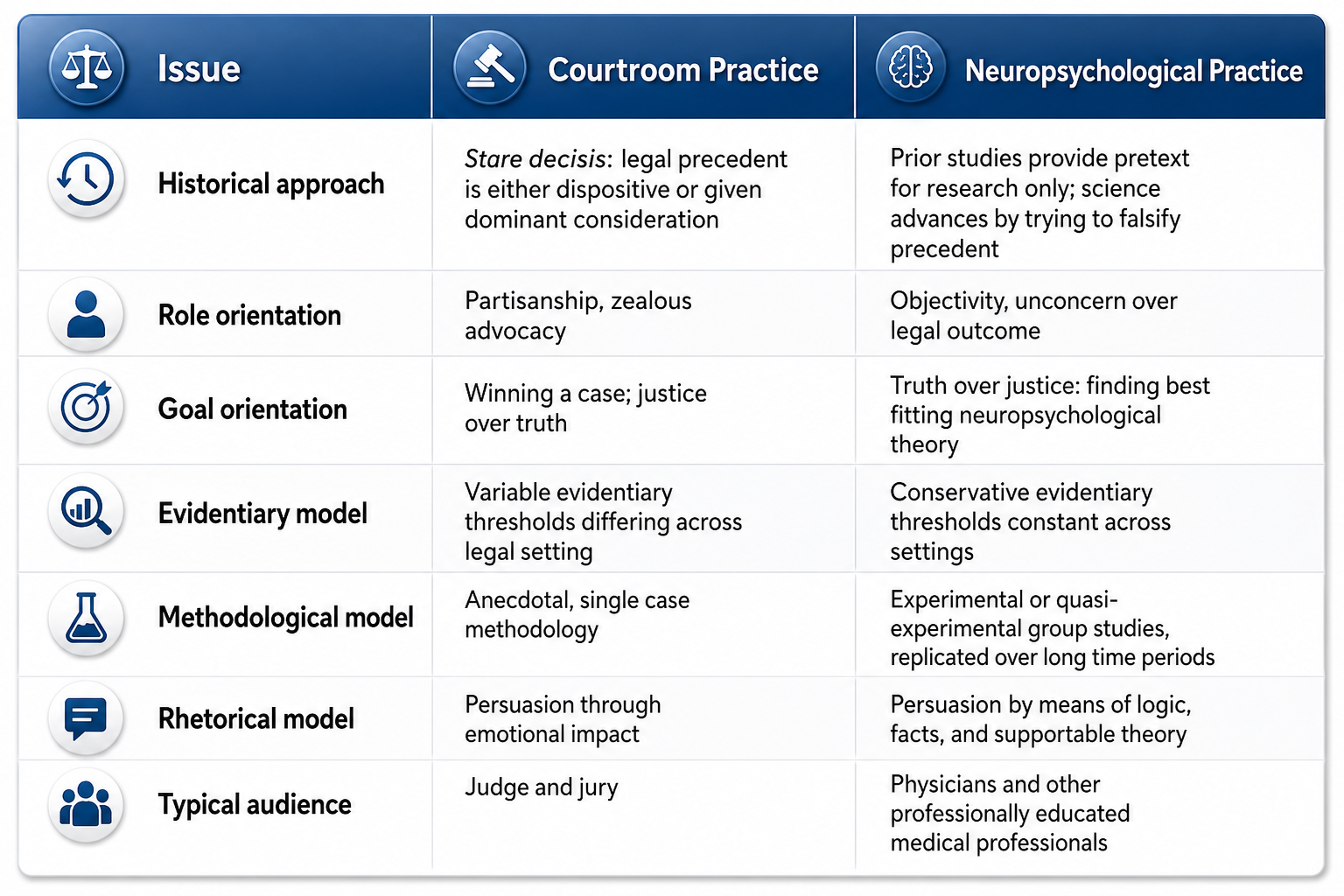
It is important to remember that even when a health professional provides clinical services to an individual involved in a potentially adversarial adjudication, the services may take on a forensic nature if the professional is called to testify, not as an expert witness, but as a fact witness (Sweet et al., 2018).
Case Examples
Several case examples of qEEG in forensic settings are provided by Chartier and Evans (2023), Cantor (2009), and Yu (2020), including those of ADHD, mild traumatic brain injury, and mitigation of a sentence for murder and rape.
Another is presented by Gluck (2011), who describes the use of qEEG in court when the death penalty was being considered as a sentence, and where qEEG findings showed frontal lobe dysregulation consistent with the defendant's lack of behavioral inhibition that had been a feature of his crime. The judge in this case considered the admissibility of qEEG findings, noting that it involves established rather than new or novel science, and that those findings and methods do not in and of themselves produce a diagnosis.
The judge concluded that the qEEG data are used together with other sources of information and viewed as consistent or not with them. Of interest, the judge noted that expert agreement about qEEG need not be unanimous. The preponderance of evidence showed that disagreement was not so wide as to reject qEEG findings.
Bonstetter, Collura, and Cantor (2018) describe a case involving qEEG and sLORETA assessment with a man charged with malice and felony murder.
Fielenbach, Donkers, Spreen, Visser, and Bogaerts (2018) provide a review of studies that examine the use of neurofeedback for criminals with various psychiatric diagnoses. Mixed outcomes were found concerning changes in EEG and behavior.
The edited text of Evans (2005) includes studies by several authors related to distinguishing qEEG features among criminals, subject attempts at deception, and neurofeedback with offenders. The literature regarding EEG abnormalities among criminals is substantial (Calzada-Reyes, Alvarez-Amador, Galan-Garcia, & Valdes-Sosa, 2021; Evans & Claycomb, 2008).
Informed Consent in Forensic Examination
Because the expert witness plays a consulting rather than treating role with the litigant, the expert witness must make their role and its limits clear to the litigant at the outset of their examination. For example, the expert should explain to the person that the "usual expectation of confidentiality does not apply, and that he or she should not provide any information to the expert that he or she does not want to be revealed to all parties involved" (Sweet et al., 2018, p. 871).
In cases when the expert conducts an independent medical evaluation, confidentiality is only between the expert and the referring third party, so the individual can access any report only through the referral source and not directly from the expert.
Important also is ensuring that the referral question is appropriate for qEEG assessment. That is, qEEG investigation is appropriate for assessment of CNS function and structure but cannot by itself directly answer questions about cognitive, behavioral, or emotional dysfunction.
The Canadian Academy of Psychologists in Disability Assessment (2000) and the American Medical Association (2016a, 2016b) have guidelines for disability assessment. Sweet et al. (2018, p. 872) present a useful table showing details that should be reviewed with litigants or claimants at the initial meeting if not before.
Reasons for the evaluation.
Referral source and relationship, if any, with the expert.
Description of the types of information to be collected.
Lack of confidentiality, making the assessment different from a normal doctor-patient relationship.
Treatment will not be offered.
The expert strives to maintain objectivity and does not act as a party with an interest in the outcome.
Importance of the examinee providing their best effort to give information and follow instructions.
Limits of qEEG Interpretation in Court
It is important to balance the potential for good and the potential for harm when testifying about qEEG in the courtroom. Caution is recommended in forensic testimony about qEEG (Coburn et al., 2006) because of the diversity of hardware and software used for qEEG, data processing methods, and the quality, size, and generalizability of normative databases used for comparing forensic cases.
As suggested by Arciniegas (2011) and Rapp et al. (2015), the use of qEEG for TBI in forensic settings is limited by the variability of abnormalities seen, especially after mild TBI, and by issues of specificity and limited replication of the scientific studies on which to base testimony.
Miller and Lindbergh (2017) summarize cautions for using qEEG in court. These include heterogeneity of qEEG patterns in TBI, poor specificity, insufficient replication, variability in data acquisition and analysis methods, and limited generalizability due to using only healthy database subjects.
However, heterogeneous qEEG findings might be expected to some degree, given the overall heterogeneity of TBI characteristics. Furthermore, qEEG findings are very consistent with TBI findings using other imaging methods (Thatcher, Biver, McAlaster, & Salazar, 1998; Thatcher, Biver, McAlaster, Camacho, & Salazar, 1998), and successful cross-validation of mild TBI case identification with discriminant function analysis has been published (Thatcher, Walker, Gerson, & Geisler, 1989).
Challenges in using qEEG in court are several. The so-called group-to-individual problem involves the fundamental division between science, which seeks generalizable findings, and law, which seeks to reach specific judgments in individual cases. The studies on which qEEG science is based use statistical averages for groups rather than presenting specific information about a single person. Different courts bridge the gap inconsistently, with some allowing expert witnesses to offer conclusions for the individual case and others restricting testimony to population-level statements while leaving it to the jury to decide applicability.
Confusion can also appear when testifying about significance testing, that is, the p-value, or likelihood that no difference between groups is true. Sometimes the low p-value of .05 is misinterpreted as low confidence in any difference between groups, perhaps because experts are often asked to state their confidence level in an opinion.
Because the results of all scientific studies do not achieve uniform agreement and may often disagree, the application of qEEG in court may be seen as unreliable, in the sense that its findings are poorly replicated across studies. However, replication is not an either-or matter, and results show degrees of consistency or inconsistency. Different courts may reach different findings depending on the degree of consistency found among replications of similar studies.
The expert witness should have detailed knowledge of the specific database used for assessment, as well as its strengths and limitations. Comparison of a record to a database may well produce a statistically significant result despite the absence of any clinically significant problem. Such a challenge makes it necessary to carefully correlate and synthesize multiple sources of information with statistically significant qEEG findings, including direct behavioral observation, self-reported and collateral history, tests of cognitive and emotional functioning, other imaging results, reports from other expert and fact witnesses, basic neuroscience, behavioral neurology, and real-world behavior.
A further caution is that the relationship between qEEG findings and behavior is not always clear at this stage of study. A pattern of abnormal qEEG findings might not be specific to a brain injury but related instead to a comorbid psychiatric condition or medication effect.
Ethics
Upholding the ethical standards of one's profession is paramount. The forensic arena, however, presents additional challenges. The expert needs to maintain high ethical standards concerning an individual case and must also protect the overall reputation of the qEEG field.
It is important to be familiar with the ethical codes of one's professional discipline (American Psychological Association, 2002). Codes such as those published by the American Psychological Association speak to issues such as boundaries of competence, knowledge of judicial and administrative standards, knowledge of the scientific basis for statements, comprehensive and accurate presentation of information, offering public statements, and avoidance of misleading statements by omission of crucial details.
Although attorneys advocate strongly for their clients, this contrasts with the expert's need to be detached and objective. The expert must maintain their objectivity and unbiased opinion in the face of attorney pressure to provide results favoring their client.
Boundaries of competence is an important issue for the qEEG expert. This applies to qEEG findings and to knowledge of the judicial rules that apply to their expert role. Different qEEG experts will have different boundaries of competence in light of their professional discipline.
It is also necessary to avoid speculation that exceeds what existing scientific knowledge and data allow. Existing knowledge and data will only allow opinions qualified to a particular level of certainty. Regardless of the data and the particular case, there is never absolute certainty. Verdicts by the trier of fact are made only to the standard of more likely than not, or beyond a reasonable doubt.
Occasionally one may encounter perceived unethical practices of colleagues. In those circumstances, one course of action is to wait until the legal matter has concluded before attempting to address the issue informally with the colleague. If doing so proves unsatisfactory, then a formal complaint may be made.
It is also important to note that defendants following conviction have brought actions against attorneys who neglected to include neuroscientific evidence in their defense (Aono et al., 2019; Chartier & Evans, 2023).
Recommendations
Chartier and Evans (2023) offer several helpful recommendations for qEEG practitioners involved in forensic matters. It is important to educate the lawyer who has engaged one's services, as well as the defendant or plaintiff, judge, and jury, and to submit peer-reviewed articles as exhibits. It is helpful to be able to testify that one uses qEEG in one's everyday clinical work or has published on the topic. Demystifying qEEG methods by using concrete metaphors and vernacular language is also important.
Chartier and Evans present a logic for the use of qEEG by those who are not physicians. Nurses, occupational therapists, psychotherapists, and psychologists work in the domain of human behavior, assessing both normal and abnormal behavior with various techniques. qEEG methods are one technique among many used in concert to understand a presenting problem, formulate a treatment plan, and perhaps make a diagnosis.
Chartier and Evans also offer an outline for sections to use in medical-legal reporting of qEEG findings, namely Introduction, History, Methodology, Raw data samples, Findings, and Summary. It is important to interpret qEEG findings in the context of multiple sources of information, including diagnostic reports based on other methods used during the same time frame as the qEEG.
Additional sources and methods to be considered when interpreting qEEG findings include basic neuroscience, behavioral neurology, neuropsychology, psychiatry and clinical psychology, probability and statistics, and direct behavioral observation.
qEEG data collected on the recommendation of an attorney for use in forensic matters should also be interpreted in the context of the litigant's personal history, whether collected from the litigant themselves or from collateral informants such as family members. Academic and medical reports from earlier stages of the person's development may be relevant.
Further Recommendations
Gluck (2011) also presents a set of recommendations. Collect a thorough history, not only from the defendant or plaintiff but from other sources such as collateral informants and professional reports. Perform a thorough neuropsychological assessment. Complete a qEEG by a professional with demonstrated training, experience, and work product involving qEEG assessment.
Use a database whose validity and reliability have been shown in peer-reviewed publications. Educate the judge and jury about qEEG and its findings by using everyday language and metaphors. Link the qEEG findings to the defendant or plaintiff's behavior, history, and other test results. Cite and explain peer-reviewed scientific articles to support interpretations.
Further recommendations for qEEG expert witness qualifications are given by Thatcher (2010).
An M.D. or doctorate in a relevant field such as neuropsychology or neurology.
Three years of clinical experience administering and interpreting qEEG data.
Board certification, for example by the International qEEG Certification Board, the American Board of Electroencephalography and Clinical Neurophysiology, or the Biofeedback Certification International Alliance.
Familiarity with the qEEG scientific literature.
Publication of scientific research related to qEEG, which is optional.
Ability to present basic information about qEEG data collection, psychometric characteristics of recordings, and abnormal and normal variant EEG.
Ability to present the original recording of EEG traces.
Ability to show examples of EEG traces demonstrating sections edited for analysis.
Ability to describe documentation for hardware and its calibration, and for the software used to process data.
Ability to describe FDA approval status for the database used.
Ability to explain that qEEG findings are not a stand-alone diagnostic test.
Ability to state the number of database subjects used for comparison to the litigant.
Ability to provide relevant qEEG scientific publications.
Ability to provide relevant LORETA scientific publications.
Recommendations can also be gleaned from the material above. In addition to adhering to ethical and legal norms, detailed preparation is central. Such preparation involves thoroughly knowing the science on which testimony will be based, including its strengths and limitations.
The use of peer-reviewed scientific publications with robust experimental designs and standardized measures is more admissible and credible than so-called junk science, whose research relies on anecdotes, single cases, and informal measures. Clear presentation of quantitative information, consideration of alternative hypotheses, and demonstration of logical reasoning that does not go beyond available data are important. Being able to state the level of certainty about one's opinions and the empirical basis for them is recommended. In addition to knowing the science behind one's opinions, knowing the law regarding confidentiality and testimony is crucial.
Summary
This section of qEEG Tutor has given an overview of medical-legal testimony and provides a glossary of terms below. The aim is to provide an introductory orientation to forensic use of qEEG findings so that the reader who is studying for IQCB certification can prepare for successful completion of the IQCB examination on Rubric IX, and also consider whether to pursue an interest in forensic applications of qEEG methods.
Coverage includes a description of forensic medicine and neuroscientific evidence and a summary of research on the effects of such evidence on legal decision-making. Uses of neuroimaging in court, and the value of qEEG findings in particular, are described. In addition to describing the legal settings in which qEEG testimony may occur, this material describes levels of legal authority from a U.S. perspective. The roles of the expert witness, judge, and trier of fact are outlined, along with concepts such as burden of proof, capacity, and competency.
After presenting relevant Federal Rules of Evidence, this section describes salient U.S. Supreme Court decisions on admissibility of evidence, namely Frye, Daubert, Joiner, and Carmichael, and how qEEG methods meet admissibility standards. qEEG cases that have been admitted to court, and those that have not, are referenced.
How a judge qualifies an expert witness to testify is described, and the process of testifying is outlined. Forensic and clinical assessment are contrasted. Special referral and informed consent considerations are presented, and case examples are given. Cautions, ethics, and recommendations are also summarized.
Check Your Understanding
- Name the four Daubert standards identified by Thatcher, Biver, and North (2003) and describe how qEEG methods address each.
- What did the 1997 AAN position paper claim, what did the rebuttals establish, and what happened to the paper in 2020?
- Explain the group-to-individual problem and describe how different courts have handled it.
- What must an expert disclose to a litigant before a forensic examination, and how does this differ from clinical informed consent?
- List four of Thatcher's (2010) recommended qualifications for a qEEG expert witness and explain why each would matter to a judge.
Cutting-Edge Topics in qEEG Research
The AAN Position Paper Retirement Changes the Argument
For over two decades, opposing counsel could wave Nuwer (1997) and assert that neurology's own academy had disavowed forensic qEEG. The American Academy of Neurology formally retired that guideline in January 2020. The paper still exists and will still be cited, but its status has changed from current position to withdrawn guidance, and knowing the date and the fact of retirement is now part of preparing to testify.
Non-Physician Experts After Kumho
Kumho Tire (1999) extended the Daubert factors to experts qualified by skill and experience rather than science alone, and explicitly included behavioral science. Chartier and Evans (2023) built on this to argue that nurses, occupational therapists, psychotherapists, and psychologists work legitimately in the domain of human behavior and may use qEEG as one technique among many. The gate is opened by demonstrated training and board certification rather than by degree, which is why credentials such as IQCB certification have grown in forensic significance.
Documented Case Outcomes Are Accumulating
The field now has published accounts of specific outcomes rather than general claims about admissibility: Gluck (2011) on a Florida death penalty case, Bonstetter, Collura, and Cantor (2018) on sLORETA in a felony murder charge, Yu (2020) on sentencing guidelines for neuro-evidence, and Thatcher's running list of cases in which qEEG was admitted. A body of case law, rather than a body of assertion, is what eventually settles admissibility questions.
Assignment
Now that you have completed this unit, explain the importance of the Daubert and Frye cases for expert testimony.
Glossary
a posteriori: formulated after the fact, once results are in, as with alternative hypotheses proposed to account for data that did not support the original prediction.
a priori: specified in advance of data collection, as with a hypothesis or analysis plan stated before an experiment is run.
acceptance, general or widespread: recognition of a method as valid by the relevant scientific community, the Frye test for admissibility and one of the Daubert factors.
affidavit: a written statement confirmed by oath or affirmation for use as evidence in court.
alpha level: the probability of a Type I error, that is, of rejecting the null hypothesis when it is true.
beta level: the probability of accepting the null hypothesis when it is false; Type II error.
Carmichael: the U.S. Supreme Court decision Kumho Tire Co. v. Carmichael (1999), extending the Daubert reliability standard to expert testimony based on technical or other specialized knowledge, with its factors applied flexibly.
confidence interval: an interval estimate generated by a procedure that, under repeated sampling and model assumptions, captures the true parameter at the stated long-run rate.
cross-examination: formal interrogation of a witness called by the opposing party in a court of law to challenge or extend testimony already given.
Daubert: the 1993 U.S. Supreme Court decision in Daubert v. Merrell Dow Pharmaceuticals that made trial judges gatekeepers of expert testimony, weighing testability, peer review, known error rate, controlling standards, and general acceptance.
de bene esse deposition: a deposition that is taken when counsel anticipates that the witness may be unavailable to testify during a trial.
deposition: out-of-court testimony given by a witness under oath before an officer authorized to administer oaths, for use later in the proceeding.
direct examination: the initial questioning of a witness by the party that called them to the stand.
discovery: a pre-trial procedure in a lawsuit in which each party can obtain evidence from the other party through the law of civil procedure.
duces tecum subpoena: a type of subpoena that requires the witness to produce a document or documents pertinent to a proceeding.
error rate: the frequency with which a technique or measurement procedure yields incorrect results, one of the Daubert factors courts weigh when judging a method's validity.
fact witness: a witness who testifies only to that of which they have firsthand knowledge and who describes only facts, as opposed to expressing opinions.
falsifiability: the property of a statement or theory of being formulated so that it permits empirical testing and can be shown to be objectively false.
Frye: the 1923 federal appellate standard from Frye v. United States admitting expert scientific testimony only when its underlying method has gained general acceptance in the relevant scientific field.
hypothesis testing: a method of statistical inference that uses sample data to decide between a null claim of no effect and a specified alternative.
instrument sensitivity: the smallest input or change that an instrument can detect reliably above noise under specified conditions.
Joiner: the U.S. Supreme Court decision in General Electric Co. v. Joiner (1997), which strengthened trial judges' gatekeeping authority by holding that extrapolation from existing data to a specific case requires more than subjective speculation.
measurement error: the difference between the observed value of a variable and the true but unobserved value of that variable.
null hypothesis: the hypothesis that there is no significant difference between specified populations, any observed difference being due to sampling or experimental error.
p value: the probability of obtaining a result at least as extreme as the one observed if the null hypothesis were true, compared against the alpha level the experimenter has chosen.
peer review: the use of scientific standards by others working in the same field to evaluate experimental work before publication.
probable cause: the evidentiary standard met when known facts would lead a reasonable person to believe that a crime has been, is being, or will be committed.
qualification: the judge’s finding that a witness possesses the knowledge, skill, experience, training, or education needed to offer expert opinion testimony.
scientific method: a method of procedure that has characterized natural science since the 17th century, consisting of systematic observation, measurement, and experiment, and the formulation, testing, and use of quantification and statistics, followed by the modification of hypotheses.
specificity (diagnostic testing): the probability that a test result will be negative when the condition is actually absent; a highly specific test produces few false positives.
standard error of measurement (SEM): the standard deviation of an individual's observed scores from their true score, used to calculate confidence intervals around obtained scores.
subpoena: a legal writ commanding a person designated in it to appear in court under a penalty for failure to do so.
Type 1 error: rejecting a null hypothesis that is actually true in the population, a false-positive error.
Type 2 error: failing to reject a null hypothesis that is actually false in the population, a false-negative error.
Test Yourself on ClassMarker
Click the button below to take a 10-question exam over this entire unit. There is no password.
Review Flash Cards on Quizlet
Click the button below to review our chapter flash cards.
References
American Medical Association. (2016a). Chapter 1: Opinions on patient-physician relationships. https://www.ama-assn.org/delivering-care/ama-code-medical-ethics
American Medical Association. (2016b). Chapter 3: Opinions on privacy, confidentiality & medical records. https://www.ama-assn.org/delivering-care/ama-code-medical-ethics
American Psychological Association. (2002). Ethical principles of psychologists and code of conduct. Author.
Aono, D., Yaffe, G., & Kober, H. (2019). Neuroscientific evidence in the courtroom: A review. Cognitive Research: Principles and Implications, 4, 1-20. https://doi.org/10.1186/s41235-019-0179-y
Arciniegas, D. B. (2011). Clinical electrophysiologic assessments and mild traumatic brain injury: State-of-the-science and implications for clinical practice. International Journal of Psychophysiology, 82, 41-52. https://doi.org/10.1016/j.ijpsycho.2011.03.004
Bonstetter, R. J. B., Collura, T., & Cantor, D. S. (2018). Application of qEEG in forensic psychiatry. International Journal of Psychophysiology, 131S, 53-54. https://doi.org/10.1016/j.ijpsycho.2018.07.015
Calzada-Reyes, A., Alvarez-Amador, A., Galan-Garcia, L., & Valdes-Sosa, M. (2021). Electroencephalographic and morphometric abnormalities in psychopath offenders. Behavioral Sciences and the Law, 39, 597-610. https://doi.org/10.1002/bsl.2548
Canadian Academy of Psychologists in Disability Assessment. (2000). Practice standards for the psychological assessment of disability and impairment. http://www.capda.ca
Cantor, D. S. (2009). Applying advanced methods in clinical practice. In T. H. Budzynski, H. K. Budzynski, J. R. Evans, & A. Abarbanel (Eds.), Introduction to quantitative EEG and neurofeedback (pp. 63-81). Academic Press.
Chartier, D. R., & Evans, J. R. (2023). Quantitative electroencephalography goes to court: Applications in liability and capital cases. In D. R. Chartier, M. B. Dellinger, J. R. Evans, & H. K. Budzynski (Eds.), Introduction to quantitative EEG and neurofeedback (3rd ed., pp. 531-541). Academic Press. https://doi.org/10.1016/B978-0-323-98927-0.00026-7
Coburn, K. L., Lauterbach, E. C., Boutros, N. N., Black, K. J., Arciniegas, D. B., & Coffey, C. E. (2006). The value of quantitative electroencephalography in clinical psychiatry: A report by the Committee on Research of the American Neuropsychiatric Association. Journal of Neuropsychiatry and Clinical Neurosciences, 18, 460-500. https://doi.org/10.1176/jnp.2006.18.4.460
Daubert v. Merrell Dow Pharm., Inc., 509 U.S. 579 (1993).
Evans, J. R. (Ed.). (2005). Forensic applications of QEEG and neurotherapy. Haworth Medical Press.
Evans, J. R., & Claycomb, S. (2008). Abnormal QEEG patterns associated with dissociation and violence. Journal of Neurotherapy, 3, 21-27. https://doi.org/10.1300/J184v03n02_03
Federal Rules of Evidence. (1975). West Publishing.
Fielenbach, S., Donkers, F. C. L., Spreen, M., Visser, H. A., & Bogaerts, S. (2018). Neurofeedback training for psychiatric disorders associated with criminal offending: A review. Frontiers in Psychiatry, 8, 1-12. https://doi.org/10.3389/fpsyt.2017.00313
Frye v. United States, 293 F. 1013 (D.C. Cir. 1923).
General Electric Co. v. Joiner, 522 U.S. 136 (1997).
Gilbert, R., Salanti, G., Harden, M., & See, S. (2005). Infant sleeping position and the sudden infant death syndrome: Systematic review of observational studies and historical review of recommendations from 1940 to 2002. International Journal of Epidemiology, 34, 874-887. https://doi.org/10.1093/ije/dyi088
Gluck, G. (2011). QEEG accepted in death penalty trial in Florida v. Nelson. Biofeedback, 39, 74-77. https://doi.org/10.5298/1081-5937-39.2.04
Greiffenstein, M. F., & Kaufmann, P. M. (2018). Basics of forensic neuropsychology. In J. E. Morgan & J. H. Ricker (Eds.), Textbook of clinical neuropsychology (2nd ed., pp. 887-926). Routledge.
Hill, A. B. (1965). The environment and disease: Association or causation? Proceedings of the Royal Society of Medicine, 58, 295-300. PMID: 14283879
Jenkins v. U.S., 307 F.2d 637 (D.C. Cir. 1962).
Kumho Tire Co. v. Carmichael, 526 U.S. 137 (1999).
Melton, G. B., Petrila, J., Poythress, N. G., & Slobogin, C. (1997). Psychological evaluations for the courts: A handbook for mental health professionals and lawyers (2nd ed.). Guilford Press.
Miller, S. L., & Lindbergh, C. A. (2017). Neuroimaging techniques in the courtroom. In S. S. Bush, G. J. Demakis, & M. L. Rohling (Eds.), APA handbook of forensic neuropsychology (pp. 111-144). American Psychological Association.
Moore, T. M., Shenal, B. V., Rhodes, R. D., & Harrison, D. W. (1999). Forensic neuropsychological evaluations and quantitative electroencephalography (QEEG). The Forensic Examiner, 8, 12-15. https://doi.org/10.1023/A:1009061601846
Nuwer, M. (1997). Assessment of digital EEG, quantitative EEG, and EEG brain mapping: Report of the American Academy of Neurology and the American Clinical Neurophysiology Society. Neurology, 49, 277-292. https://doi.org/10.1212/wnl.49.1.277
Rapp, P. E., Keyser, D. O., Albano, A., Hernandez, R., Gibson, D. B., Zambon, R. A., Hairston, W. D., Hughes, J. D., Krystal, A., & Nichols, A. S. (2015). Traumatic brain injury detection using electrophysiological methods. Frontiers in Human Neuroscience, 9, 11. https://doi.org/10.3389/fnhum.2015.00011
Swanson, J. A., Schmitz, D., & Chung, K. C. (2010). How to practice evidence-based medicine. Plastic and Reconstructive Surgery, 126, 286-294. https://doi.org/10.1097/PRS.0b013e3181dc54ee
Sweet, J. J., Kaufman, P. M., Ecklund-Johnson, E., & Malina, A. C. (2018). Forensic neuropsychology. In J. E. Morgan & J. H. Ricker (Eds.), Textbook of clinical neuropsychology (2nd ed., pp. 857-886). Routledge.
Thatcher, R. W. (2010). Minimal qualifications for an individual to be considered as a QEEG expert for purposes of admission of QEEG in a court of law. https://www.appliedneuroscience.com/PDFs/Minimal_Standards_for_qEEG_Experts.pdf
Thatcher, R. W. (n.d.). Partial list of cases that QEEG was admitted as evidence at trial. https://appliedneuroscience.com/PDFs/QEEG%20CASES%20ADMITTED-updated.pdf
Thatcher, R. W., Biver, C., McAlaster, R., Camacho, M., & Salazar, A. (1998). Biophysical linkage between MRI and EEG amplitude in closed head injury. NeuroImage, 7(4 Pt 1), 352-367. https://doi.org/10.1006/nimg.1998.0330
Thatcher, R. W., Biver, C., McAlaster, R., & Salazar, A. M. (1998). Biophysical linkage between MRI and EEG coherence in traumatic brain injury. NeuroImage, 8, 307-326. https://doi.org/10.1006/nimg.1998.0365
Thatcher, R. W., Biver, C. J., & North, D. (2003). Quantitative EEG and the Frye and Daubert standards of admissibility. Clinical Electroencephalography, 34, 1-15. https://doi.org/10.1177/155005940303400203
Thatcher, R. W., Moore, N., John, E. R., Duffy, F., Hughes, J. R., & Krieger, M. (1999). QEEG and traumatic brain injury: Rebuttal of the American Academy of Neurology 1997 report by the EEG and Clinical Neuroscience Society. Clinical Electroencephalography, 30, 94-98. https://doi.org/10.1177/155005949903000304
Thatcher, R. W., North, D. M., Curtin, R. T., Walker, R. A., Biver, C. J., Gomez, J. F., & Salazar, A. M. (2001). An EEG severity index of traumatic brain injury. Journal of Neuropsychiatry and Clinical Neurosciences, 13, 77-87. https://doi.org/10.1176/jnp.13.1.77
Thatcher, R. W., Walker, R. A., Gerson, I., & Geisler, F. (1989). EEG discriminant analyses of mild head trauma. EEG and Clinical Neurophysiology, 73, 93-106. https://doi.org/10.1016/0013-4694(89)90188-0
Wikipedia. (2023). Daubert standard. Retrieved August 16, 2023, from https://en.wikipedia.org/wiki/Daubert_standard
Yu, D. (2020). Application of neuroscience evidence on court sentencing decisions: Suggesting a guideline for neuro-evidence. Seattle Journal for Social Justice, 18, 493-523. https://digitalcommons.law.seattleu.edu/sjsj/vol18/iss2/19